Guide
Non-scale victories: what to track instead of the number on the scale

Why the scale is so noisy
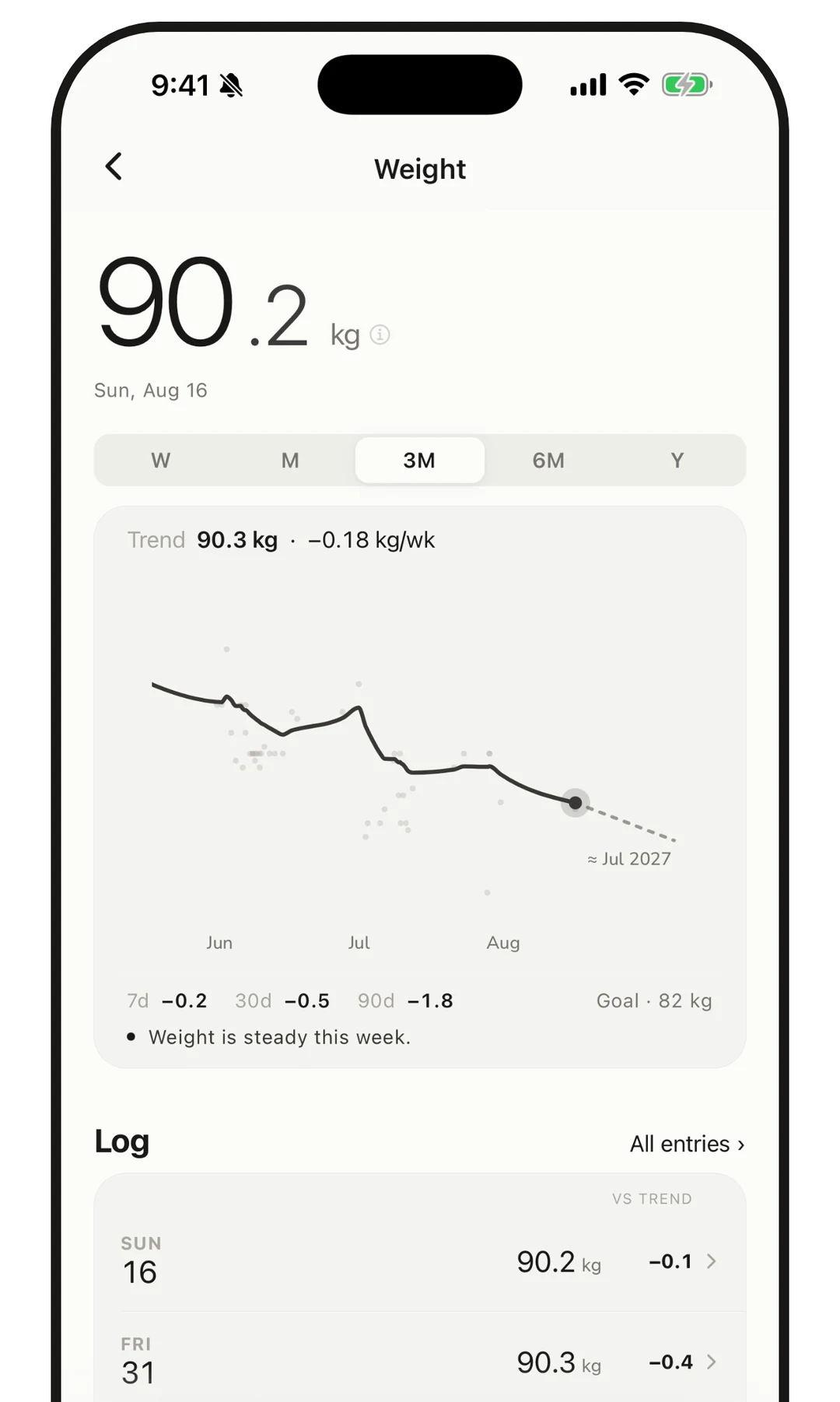
Body weight is mostly water. A big salty dinner, a hard workout, a long flight, more carbs than usual, or a point in the menstrual cycle can each shift how much fluid you hold by a kilo or more — none of it fat. Glycogen, the carbohydrate your muscles store, pulls water with it, so the first week of eating less almost always shows a drop that is partly “whoosh” and partly real.
Fat itself changes slowly. Even an aggressive, sustainable deficit is a few hundred grams of fat a week — well inside the daily wobble of the scale. So on any given morning the number is mostly telling you about yesterday’s salt and water, not the month’s trend.
What to track instead
Pick two or three of these — not all of them. The point is a small, honest weekly check-in, not another spreadsheet.
How your clothes fit
A waistband is a better tape measure than a daily weigh-in. Same pair of jeans, same day of the week, same time — looser is progress the scale often hides for weeks.
Afternoon energy
Steadier energy through the 3 pm slump is one of the first things people notice when eating and sleep improve. Rate it 1–5 at the same time each day.
Sleep
How long you slept, and how rested you feel. Better sleep both reflects and drives the other changes, which is why it is worth its own line.
Training performance
One more rep, a walk that felt easier, a faster recovery between sets. Performance going up while weight holds steady usually means body composition is moving.
Cravings and mood
Fewer swings, less all-or-nothing thinking about food. Hard to quantify, easy to feel — a weekly 1–5 is enough.
Habit consistency
The most predictive one, and the only input you fully control: days logged, meals that hit your protein target, the step floor you met. Five good days out of seven, repeated, is what the slower signals are made of.
How to actually notice them
- Choose two or three. Rate them 1–5 once a week, same day, same time.
- Write one sentence about the week next to the ratings.
- If your tracker surfaces these patterns for you, let it. Elo names non-scale wins as they happen — an energy streak, a run of better nights — instead of leaving you to spot them.
When the scale is still useful
A weekly or smoothed trend line, looked at monthly, is a fair progress check. And in medical contexts — some medications, some conditions — a clinician may want the actual number tracked closely. That is between you and them; see our medical disclaimer.
Elo tracks all of these — sleep, energy, activity, habits — and tells you what the week added up to, without leading with a scale number.
get elo — freefree to start · no card · leave anytime
Is it normal for my weight to go up overnight?
Yes. A rise of 0.5–2 kg from one day to the next is almost always water, food still in your system, and glycogen — not body fat. Fat change that fast is not physically possible from a single day of eating.
How often should I weigh myself?
If weighing helps you, a daily reading fed into a smoothed trend line is fine — look at the trend weekly or monthly, not the raw number. If the daily number sends you into an all-or-nothing spiral, weigh weekly or stop and use the non-scale signals below.
What counts as a non-scale victory?
Any concrete sign that things are moving the right way that is not the scale: clothes fitting differently, steadier afternoon energy, better sleep, easier workouts, fewer cravings, and simply keeping your habits going for more days in a row.
How long until fat loss shows up on the scale?
Usually two to four weeks before a real downward trend is visible through the day-to-day noise, and longer if the change is small. This is exactly why slower signals are worth tracking in the meantime.
Sources
- Mayo Clinic — “Why does my weight fluctuate?” — on daily water-weight swings
- NHS — Managing your weight
- CDC — Losing weight: getting started
- Elo — App Store listing — add the real URL — playbook checklist 8.6
Links checked [add real date] — pages move.